


A very happy Amelia Cosgrove enrolled on Stokes’ Coffee Tasting Experience at the learn – here’s what she learned about her morning cup of joe.

Expect to arrive and be greeted by coffee connoisseur Mike Palliser, who breaks the experience into three stages: lesson, demonstration and tasting – or, as the online description aptly puts it – ‘Charlie and the Chocolate Factory for grown-ups’.
And what better place to learn from the best of the best?
Stokes Coffee and Tea has been roasting in Lincoln since 1902, so you could say they have had rather a long time to perfect the art.
Lesson
First, Mike fills our minds with facts, tales and stories before filling our cups.
Beginning at the Stokes Barista Training Academy, he takes us through the surprisingly rich history of coffee before we get anywhere near the tasting table.
I won’t spoil it for you, but my core takeaway was just how far coffee has travelled – changing cultures, fuelling revolutions and becoming far more than something we drink when we're tired.
Historically, coffee houses became places to meet, debate, exchange ideas and presumably, avoid going home when the conversation was getting good.
What began as a plant grown in tropical climates became one of the world's most consumed drinks, which makes our morning habit feel considerably more sophisticated than simply needing caffeine before speaking to anyone.
Coffee can be enveloping and warm like a hug, but it can also be strong and pungent. Prepared badly, it can taste almost burnt. Add milk and it softens; add sugar and it transforms. There are coffees that taste smooth and chocolaty, others that are floral, sharp, fruity or even reminiscent of tobacco.
And that explains why coffee has become so synonymous with hospitality. ‘Shall we go for a coffee?’ rarely means simply let's consume a hot beverage, what we’re asking is ‘Let's meet for a chat’.
For people like me, who refuses to make one if I'm in a rush because, frankly, the process needs time, we see coffee as a ritual. For others, it is a quick caffeine hit.
I hunt for good-quality beans, enjoy experimenting with brewing methods and as Mike reminded us, even the water matters. Good, filtered water can make a surprisingly significant difference to the finished cup.
A cafetière is slow and teaches patience. Espresso machines give you that velvety crema, while different origins and roasts completely alter the character of the finished drink.
Mike also offered a useful reality check for anyone who, like me, gets slightly overexcited in the coffee aisle: once opened, coffee is best consumed relatively quickly. Those beautiful beans don't stay at their peak forever, becoming, as Mike put it ‘increasingly gassy as they age’.
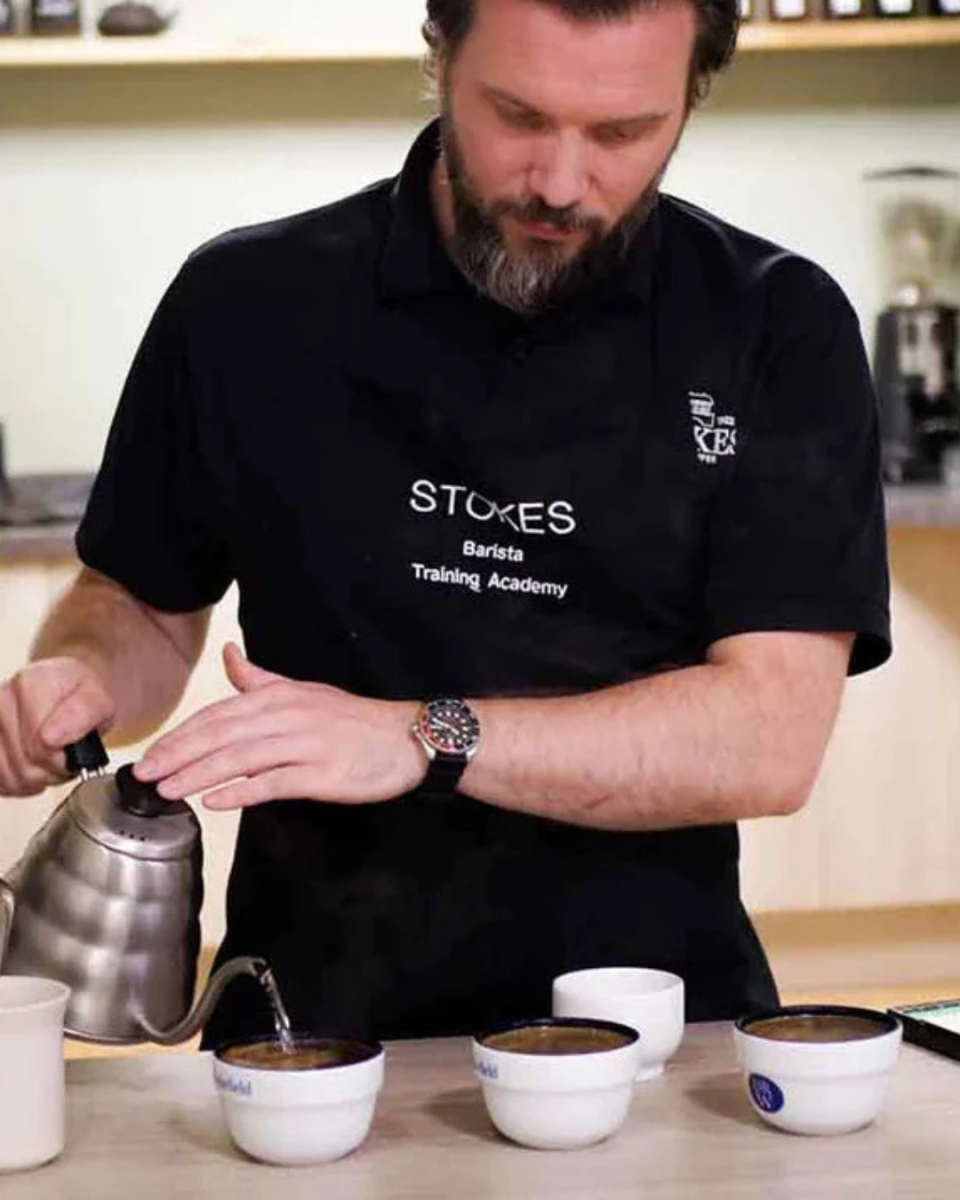
Demonstration
The lesson was followed by a look at roastery process, where Mike demonstrated how green coffee beans are transformed through roasting.
We watched the beans tumble through the machine as they gradually changed colour, while Mike brought samples out at different stages for us to see and smell. It was surprisingly mesmerising.
Seeing the process up close made one thing very clear: that little brown seed- turned-bean in your kitchen has been through quite a journey before it reaches your cup.
Then came the tasting.
Tasting time
Our group of nine was nicely mixed, which actually suited the experience. You didn't need to be a coffee obsessive or arrive knowing your Arabica from your Robusta. You merely needed to be curious.
Nine coffees were laid around a round table, each accompanied by information about its origin, altitude, variety, processing method, roast and tasting notes - we were about to drink our way around the world.
Mike first showed us how professional coffee cupping works.
Each of us had our own cup and spoon, and we worked our way around the table, taking two spoonfuls from each coffee to cleanse the palate before tasting it properly.
Then came the slurping.
Forget dainty little sips. To properly taste the coffee, you are encouraged to slurp it quite aggressively, pulling air through the coffee to help unlock its aromas and flavours.
It feels ridiculous for approximately three seconds, then you realise you can actually taste the difference.
Working our way around the table, we made notes in our own little coffee-tasting books. By the time we returned to our original coffee, I was smelling, tasting and thinking about coffee in a completely different way – and had enough caffeine coursing through me to bounce around the room like a human espresso shot.
My favourite?
My favourite medium roast was the Blue Mountain from Colombia, with smooth raisin-like sweetness and milk chocolate notes.
Mike described it as one of the most versatile roasts, working across different brewing methods, from cafetière to filter.
But my favourite discovery was the light roast: Midnight Flyer from Uganda.
The aroma immediately reminded me of marshmallow, while the taste had a bright blackcurrant note.
It was beautiful, fruity and completely unlike the coffee I would normally choose for my morning cup.
Coffee as a sensory experience
What surprised me most wasn't how much I learned about coffee; it was how present the experience made me feel.
There is something strangely grounding about being asked to stop and concentrate on one thing.
Smell this.
Taste this.
What can you notice?
Write it down.
For an hour or so, there was nowhere else to be. No phone scrolling, no rushing through a coffee between meetings, no drinking something simply because I needed caffeine.
Just smell, taste and sensation.
So, is it worth doing?
If you are already a coffee lover, this is an easy recommendation. If you're not, but you're curious, it's equally worthwhile.
You get to go behind the scenes of a Lincoln institution, see how coffee is roasted and taste nine very different coffees under the guidance of someone who knows exactly what they are talking about.
And you leave with more than a caffeine buzz.
You leave knowing a little more about why your favourite coffee tastes the way it does, which roast suits you and how origin, processing and preparation can transform a cup.
For me, though, the biggest takeaway was simpler: sometimes the best way to enjoy your morning coffee is to stop treating it as part of the morning rush, but as an experience itself.
Good to know - If you discover a favourite during the tasting, you can pick up a bag of different Stokes beans from the shop to take home. And if you’re a regular at The Lawn Café, there’s another reason to keep coming back: the café rotates the beans it uses in its coffee each month, giving you the chance to taste something new.